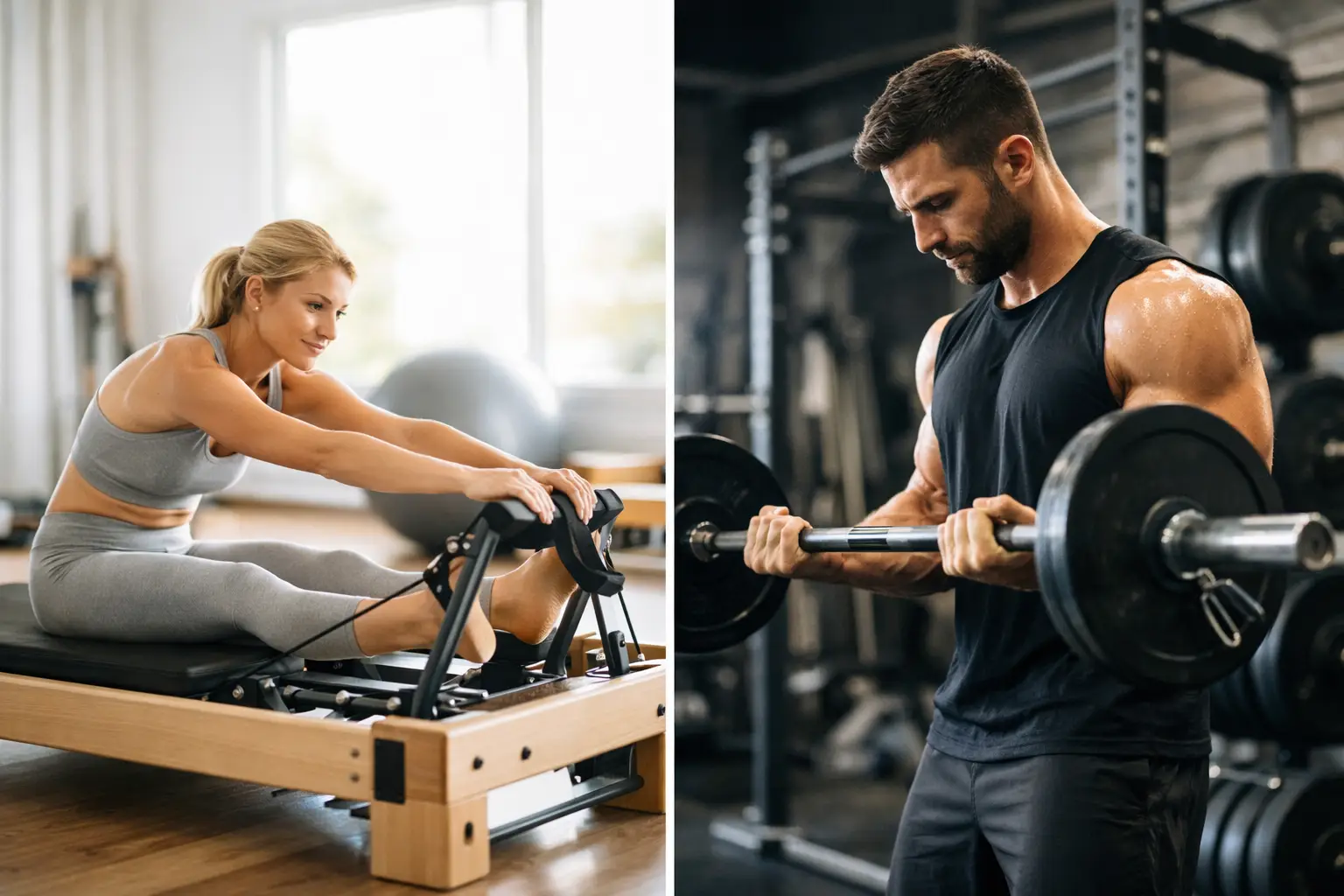
You do not need to pick a side forever. When people ask about pilates vs strength training, they are usually really asking something more personal: What will help me feel stronger, move better, and stay consistent enough to see results?
That is the right question. For most adults, especially those balancing work, family, stress, and changing energy levels, the best workout is not the trendiest one. It is the one that supports your body, fits your life, and helps you build real progress without burning out.
Pilates vs strength training: what is the real difference?
At a basic level, Pilates is a movement method focused on core control, alignment, posture, breathing, stability, and mobility. Strength training is a style of exercise built around resistance to help your muscles produce more force over time. That resistance might come from dumbbells, kettlebells, machines, resistance bands, or your own body weight.
The biggest difference is not that one is “hard” and the other is “gentle.” Both can be challenging. The difference is in what each method prioritizes.
Pilates tends to emphasize precision, control, muscular endurance, joint support, and body awareness. Strength training tends to emphasize progressive overload, muscle development, power, and total-body strength. One teaches you how to move well. The other pushes your body to handle more load. Both matter.
This is where people can get confused. Pilates absolutely builds strength, especially in the core, hips, glutes, and stabilizing muscles. Strength training can also improve mobility and posture when coached well. So this is not a battle between opposites. It is more of a question of emphasis.
When Pilates may be the better fit
If your body feels stiff, your posture is slipping, or your lower back and hips are always talking to you, Pilates can be an excellent place to start. It teaches you how to connect with muscles that often get ignored in everyday life and in fast-paced workouts.
Many beginners also feel more confident starting with Pilates because it improves body awareness. You learn what neutral alignment feels like. You notice whether you are gripping your neck, arching your back, or letting your shoulders take over. That kind of awareness can change the quality of every other workout you do.
Pilates is also helpful for people returning to exercise after a long break, managing stress, or looking for a lower-impact option that still feels purposeful. It can improve posture, core endurance, flexibility, balance, and movement control in a way that carries into daily life. You may notice it when you stand taller, bend down more easily, or stop feeling wiped out by simple physical tasks.
That said, Pilates has limits if your main goal is maximizing muscle mass or building high levels of strength. You can get stronger with Pilates, but if you want to significantly increase how much resistance your body can handle, traditional strength training usually gets you there faster.
When strength training may be the better fit
If your goal is to build muscle, improve bone health, get stronger for everyday life, or increase your metabolism over time, strength training deserves a major place in your routine. It is one of the most effective tools for creating measurable physical change.
Strength training helps with far more than appearance. It can make carrying groceries easier, improve joint support, increase confidence, and help your body stay resilient as you age. For adults who want long-term function, this matters. Muscle is not just about looks. It is one of the keys to staying capable and independent.
It can also be empowering in a very direct way. Adding weight to a lift, completing more reps, or mastering a movement pattern gives you clear feedback that you are progressing. That kind of progress can be incredibly motivating.
Still, strength training is not automatically the best first step for everyone. If you jump into loaded exercises without enough mobility, control, or coaching, you may compensate with poor form. That is when people start saying things like, “lifting just hurts my back” or “my shoulders always feel tight after workouts.” Often, the issue is not strength training itself. It is the lack of movement foundation underneath it.
Pilates vs strength training for weight loss
This is one of the most common comparisons, and the honest answer is that neither one works like magic on its own. Weight loss depends on many factors, including nutrition, sleep, stress, consistency, and total activity level.
Strength training often gets more attention for body composition because it helps preserve and build lean muscle. That can support a healthier metabolism and give your body a firmer, stronger look over time. Pilates can support weight loss too, especially if it helps you move more consistently, improve energy, and stay connected to healthy habits.
If someone hates heavy lifting but loves Pilates and actually shows up three or four times a week, that consistency may beat a strength plan they quit after two weeks. On the other hand, if someone wants more visible muscle definition and stronger performance, strength training usually has the edge.
The real win is choosing a plan you can stick with long enough for results to show up.
Why many people do best with both
For most people, pilates vs strength training is not really an either-or decision. It is a both-and conversation.
Pilates can improve the quality of your strength training by helping you stabilize better, breathe better, and control your movement. Strength training can improve the results you get from Pilates by increasing force production, muscle strength, and overall physical capacity.
Together, they create a more balanced body. You get stronger, but you also move with more control. You build muscle, but you also improve posture and mobility. You challenge yourself, but you support recovery and joint health at the same time.
This combination is especially valuable for adults who want sustainable progress. Not punishment. Not all-or-nothing intensity. Real training that helps you feel better in your body now and years from now.
At TNT Fitness Studio B, this is exactly why so many people respond well to a mix of Pilates and strength-based circuit training. One supports alignment and control. The other builds capacity and confidence. Together, they create momentum.
How to choose based on your current goal
If your top priority right now is improving posture, reducing stiffness, rebuilding confidence with exercise, or strengthening your core in a lower-impact way, Pilates may be the best place to begin. It gives you a foundation you can build on.
If your top priority is gaining muscle, increasing strength, improving bone density, or changing body composition, strength training should probably lead your program.
If you are dealing with inconsistent energy, past injuries, or fear around exercise, the smartest path may be starting with the method that feels most approachable. Fitness does not have to begin with max effort. It has to begin with trust. Once your body and confidence catch up, you can layer in more challenge.
And if you already exercise regularly but feel tight, disconnected from your core, or stuck in repetitive training, Pilates may be the missing piece that helps everything else work better.
What beginners often get wrong
A lot of people assume Pilates is easy because it is low impact. Then they take a class and realize controlled movement can be deeply challenging. Others assume strength training means going heavy right away, when the real first step is learning how to hinge, squat, press, brace, and recover well.
Another common mistake is choosing based on what looks hardest instead of what makes sense for your body. Harder is not always better. Smarter usually wins.
The goal is not to prove something in one workout. The goal is to build a routine you can return to consistently. That is where transformation happens – not through random bursts of motivation, but through steady training that matches your needs.
A better question than which one is better
Instead of asking whether Pilates or strength training is better, ask what your body needs most right now. Do you need more stability? More strength? Better mobility? More confidence? A routine you will actually enjoy enough to keep going?
That answer can change over time, and that is okay. Your training should support the season you are in, not pressure you into someone else’s idea of fitness.
The best program is the one that helps you feel stronger in real life, more connected to your body, and confident enough to keep showing up. Start there, stay consistent, and let progress build from the inside out.