The first Pilates class can feel deceptively easy until you realize how much control it asks from your core, hips, shoulders, and breath. If you are wondering how to start Pilates safely, the goal is not to push through every move. It is to learn your body, build a strong foundation, and give yourself room to improve with confidence.
That matters because Pilates is low impact, but low impact does not mean effortless. Good Pilates work asks for precision, alignment, and patience. When you start the right way, you are much more likely to feel the benefits people come for in the first place – better posture, stronger core support, improved mobility, and more body awareness in everyday life.
Why starting Pilates safely matters
A lot of beginners assume the safest approach is simply choosing a beginner class. That helps, but safety is really about matching the workout to your current fitness level, injury history, and movement habits. Someone who walks daily but has tight hips and back pain may need a different starting point than someone who lifts weights regularly but struggles with balance and breathing control.
Pilates can support both of those people well, but only when the focus stays on quality over intensity. Rushing into advanced movements, copying the person next to you, or treating every class like a competition usually leads to compensation. That is when the neck grips, the lower back arches too much, or the shoulders start doing work the core should be helping with.
Starting safely gives you a better payoff. You build strength in the muscles that stabilize your spine and pelvis, improve flexibility without forcing it, and develop movement patterns that carry over into work, walking, lifting, and training.
How to start Pilates safely before your first class
Before you step onto the mat, take a quick inventory of your body. If you have current pain, old injuries, are postpartum, or are returning to exercise after a long break, that is worth sharing with your instructor. This is not oversharing. It is useful coaching information.
A good instructor can offer modifications, suggest props, and help you avoid positions that are not right for you yet. That kind of support often makes the difference between a class that feels frustrating and one that feels challenging in a productive way.
It also helps to set the right expectation. Your first few sessions are not about doing everything perfectly. They are about learning how to brace your core without holding your breath, how to move with control, and how to notice the difference between muscular effort and joint discomfort.
Wear clothes you can move in comfortably, and do not worry about looking like an expert. Pilates is not about performing. It is about practicing.
Choose the right class format
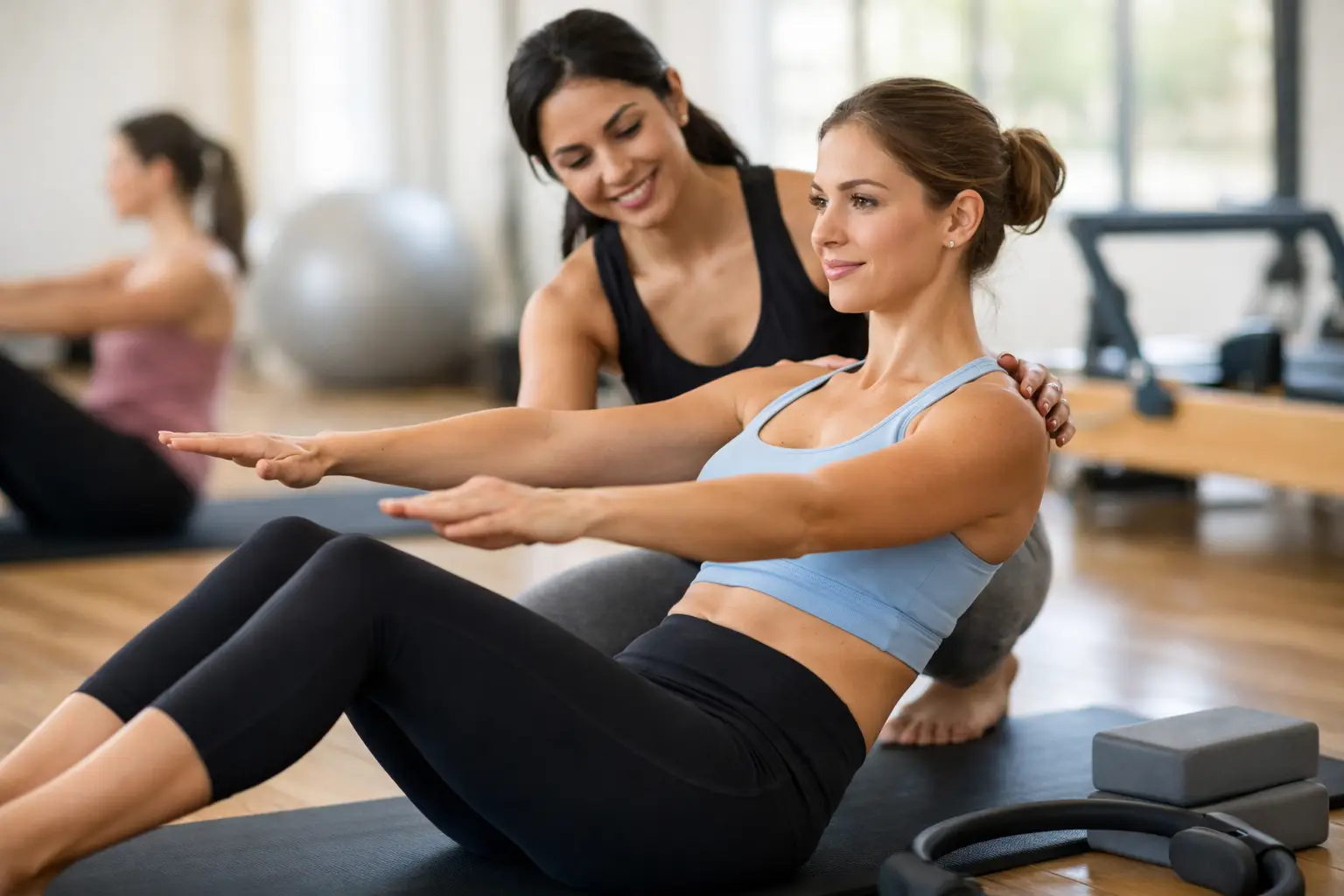
If you are brand new, start with a true beginner class or a studio that offers hands-on guidance and coaching. That environment usually gives you more attention to form, pacing, and setup. For many adults, especially those who want structure and accountability, an in-person class is a smarter starting point than jumping into random online videos.
That said, the best format depends on your needs. Group classes can be motivating and energizing. Private or semi-private sessions can be better if you are dealing with pain, major mobility restrictions, or nerves about getting started. Neither option is better for everyone. The safest choice is the one that gives you enough instruction to move well.
What good form feels like in Pilates
Pilates uses small adjustments that make a big difference. You do not need to memorize every cue on day one, but a few basics can help you stay safer and more connected during class.
Your breath should stay steady. If you are bracing so hard that you cannot inhale fully or exhale with control, you are probably overworking. Your neck and jaw should stay relaxed as much as possible. If your shoulders creep up toward your ears, back off and reset.
Neutral alignment matters too. In many exercises, you want your ribs stacked over your pelvis rather than flaring the ribs or tipping the pelvis dramatically. That creates a more stable base for the core to work from. It may feel subtle, but subtle does not mean ineffective.
The other big signal is where you feel the work. Core exercises should not dump pressure into your lower back. Glute and leg work should not create pinching in the hips. If something feels sharp, unstable, or wrong, stop and ask for a modification.
Breathing is part of the exercise
A lot of people hold their breath when a movement gets hard. In Pilates, that usually makes things harder, not easier. Controlled breathing helps you organize your trunk, connect with your deep core, and reduce tension in places like the neck and shoulders.
You do not need perfect technique right away. Just focus on breathing in a way that feels steady and intentional. Over time, your breath becomes one of the tools that makes the workout safer and more effective.
Common mistakes beginners make
One of the most common mistakes is trying to get bigger range of motion than your body can control. Lifting the legs higher, sinking deeper into a stretch, or curling farther off the mat is not automatically better. In Pilates, a smaller movement done well usually beats a bigger movement done poorly.
Another mistake is moving too fast. Momentum can hide weak spots for a few reps, but it also makes it easier to lose alignment. Slow, controlled reps give you feedback. They show you where you are stable and where you need more support.
Beginners also tend to ignore fatigue signals because the class does not look intense in the traditional sense. But shaking, loss of form, or feeling your lower back take over are signs to pause. Rest is not failure. It is part of training intelligently.
How often should you do Pilates at first?
For most beginners, two to three sessions per week is a solid place to start. That is enough to build familiarity and strength without overwhelming your body. More is not always better in the beginning, especially if you are also doing strength training, running, or high-intensity classes.
Your recovery matters. If you leave Pilates feeling worked in a good way and can return with decent energy, you are probably in the right range. If you feel sore in the joints, unusually drained, or more stiff than mobile, you may need to scale back or adjust the class level.
Consistency usually beats intensity here. A manageable routine helps you develop skill, and Pilates is very much a skill-based practice.
How to start Pilates safely if you have pain or limitations
Many people come to Pilates because they want relief from stiffness, poor posture, or recurring aches. It can absolutely support those goals, but it should not turn into a self-diagnosis plan. If you have significant pain, numbness, dizziness, or a medical condition that affects exercise, check with a healthcare professional first.
Once you are cleared, be honest with your instructor. Safe Pilates often means modifying range of motion, using props, changing position, or skipping a movement entirely. That is normal. Smart modifications are part of progress, not a detour from it.
This is where a coaching-focused studio can make a real difference. At TNT Fitness Studio B, that guided approach helps beginners feel supported while they build strength, mobility, and confidence at a pace that makes sense for their body.
What progress should feel like
Early Pilates progress does not always look dramatic. You may notice that your posture feels easier to maintain at your desk, your lower back feels less irritated after a long day, or your core engages more naturally during other workouts. Those are real wins.
You may also notice that exercises that once felt confusing begin to click. Your balance improves. Your shoulders feel more open. You can control the lowering phase of a movement instead of dropping out of it. That kind of progress lasts because it is based on awareness and control, not just effort.
If you want to keep Pilates safe and sustainable, stay curious instead of judgmental. Ask questions. Take modifications when you need them. Let good technique become your version of intensity.
Pilates works best when you treat it like a practice you grow into, not a test you have to pass. Start with patience, listen to your body, and trust that strong foundations create lasting results.