You do not need to be naturally bendy to start flexibility training for beginners. Most people begin because something feels tight, stiff, or harder than it should – reaching overhead, sitting with better posture, getting up from the floor, or recovering after a workout. That is a great place to start, because flexibility is not about forcing extreme ranges of motion. It is about helping your body move with less restriction and more confidence.
For many adults, tight hips, rounded shoulders, and a stiff lower back are not signs of failure. They are signs of long workdays, commuting, stress, and workouts that build strength without enough mobility work around them. The good news is that flexibility can improve at any stage when you train it with patience and consistency. You do not need long sessions or complicated routines. You need a smart starting point and a plan you can stick with.
What flexibility training for beginners really means
A lot of people lump flexibility, mobility, and stretching into one category. They are related, but they are not exactly the same. Flexibility is your muscles’ ability to lengthen. Mobility is how well your joints move through a controlled range of motion. In everyday life, you need both.
That matters because stretching alone does not automatically improve movement quality. If your hips are loose but you cannot control them, you may still feel unstable in squats, lunges, or even walking up stairs. If your shoulders are flexible but your upper back is stiff, reaching overhead can still feel awkward. The best beginner approach blends gentle stretching with light strength and control work so your body can actually use the range you build.
This is also why progress can feel uneven. One person needs more work in the calves and hamstrings. Another needs more attention in the chest, hip flexors, and thoracic spine. There is no perfect universal routine. There is only the routine that matches how your body moves right now.
Why beginners should start small
One of the biggest mistakes beginners make is stretching too aggressively. If a stretch feels sharp, pinchy, or like a fight, your body usually responds by tightening more. That can leave you sore without improving anything meaningful.
A better approach is to work at a moderate sensation – enough to feel the stretch, not so much that you hold your breath or brace your jaw. If you can breathe steadily and stay relaxed, you are probably in a useful range. This is where flexibility actually starts to build.
Short sessions also work better than occasional marathon sessions. Ten minutes three or four times a week usually beats one long session on Sunday. Your body responds well to repeated reminders. Consistency is what changes tissue tolerance, body awareness, and movement habits over time.
The best areas to focus on first
If you are new to flexibility work, start with the places that affect daily movement the most. For many adults, that means hips, hamstrings, calves, chest, and upper back.
Tight hips can make walking, lunging, and sitting on the floor feel limited. Hamstrings and calves often affect bending, squatting, and overall lower body comfort. A tight chest and stiff upper back can pull posture forward and make shoulder movement less efficient. When you improve these areas, you often notice changes quickly – standing taller, moving more easily, and feeling less beat up after strength training or long days at a desk.
That said, if you have a history of injury or one area feels especially restricted, it is worth getting coaching. Sometimes what feels tight is actually weakness or poor control in a nearby joint. Personalized guidance can save you a lot of guesswork.
A simple beginner routine that makes sense
You do not need twelve stretches. You need a few good ones done well. A practical flexibility session for beginners might start with two or three minutes of gentle movement to warm up. Marching in place, arm circles, cat-cow, or bodyweight squats work well because they increase circulation without exhausting you.
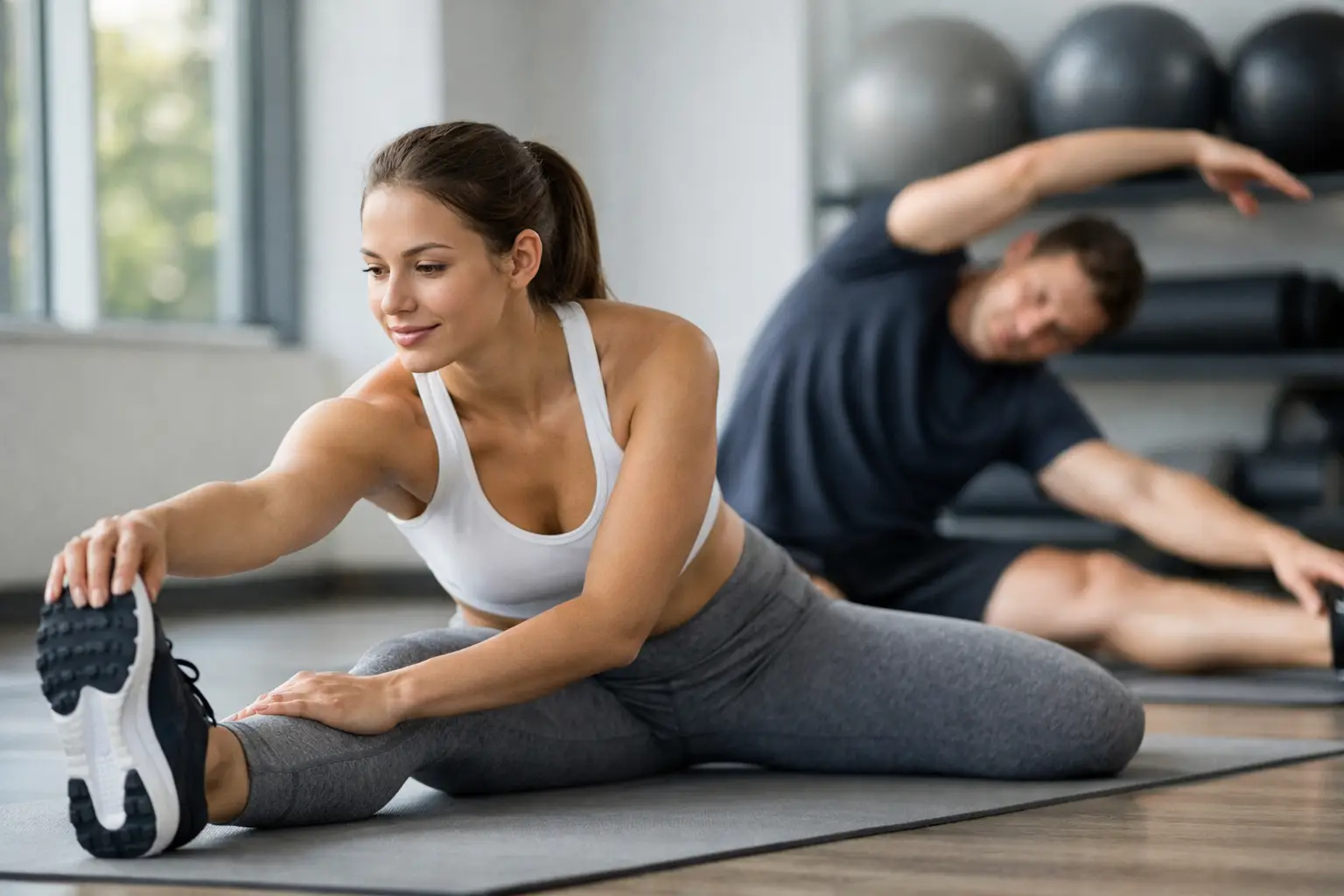
From there, hold each stretch for about 20 to 30 seconds and repeat it one to three times. A half-kneeling hip flexor stretch can help open the front of the hips. A seated or lying hamstring stretch can reduce pulling through the back of the legs. A calf stretch against a wall helps with ankle mobility and lower leg stiffness. For the upper body, a doorway chest stretch and a thread-the-needle rotation can improve how the shoulders and upper back feel.
After stretching, add one or two simple control exercises. Glute bridges, dead bugs, and slow bodyweight squats are great choices. They help your body use the new range of motion instead of losing it as soon as the stretch ends. That combination – stretch, then stabilize – is where a lot of beginners finally start noticing real progress.
How often to train and what to expect
Most beginners do well with flexibility training three to five times per week. That does not mean every session needs to be long. Some days it may be a focused 15-minute routine. Other days it may be five minutes after a workout or before bed.
Results depend on your starting point, consistency, age, injury history, and daily habits. If you sit for most of the day, your flexibility work has to compete with many hours in the same position. That does not mean improvement is impossible. It just means you should expect gradual progress, not overnight change.
Many people notice small wins first. Your warm-up feels easier. You can get deeper into a squat. Your shoulders feel less tense. Posture improves because your body is not fighting the same restrictions all day. Those small wins matter. They are signs that the process is working.
Common beginner mistakes
Trying to copy advanced flexibility work is usually the first problem. Social media tends to reward dramatic poses, not good progression. Deep backbends and splits are not the goal for most people. Better everyday movement is.
The next mistake is stretching cold and expecting your body to cooperate. Even a brief warm-up can make a big difference. Another common issue is inconsistency. People stretch hard for three days, get sore, stop for a week, then decide flexibility does not work for them. The body responds better to steady, manageable work.
It is also easy to ignore strength. If you only chase more range without building support around it, movement can feel loose but not better. This is where Pilates, controlled circuit training, and coached mobility work can be so effective. They build awareness, alignment, and strength alongside flexibility, which is exactly what many beginners need.
When flexibility training feels frustrating
Some areas improve quickly. Others take time. Hips and shoulders often respond differently from person to person, and anatomy plays a role. Not every body is built for the same shape or depth in every stretch. That is normal.
If one position always feels painful, stop forcing it. Try a different angle, reduce the intensity, or swap the stretch entirely. A stretch should challenge you, not create joint pain or numbness. If symptoms keep showing up, professional coaching is the smarter move.
Support also matters more than people think. It is easier to stay consistent when someone checks your form, adjusts the movement, and helps you see progress you might miss on your own. That is one reason guided classes and coaching can be such a strong fit for beginners. At TNT Fitness Studio B, flexibility and mobility are part of a bigger picture that includes strength, posture, body awareness, and sustainable progress.
Building flexibility into real life
The best routine is the one that fits your schedule. If mornings are rushed, do five minutes after your workout. If evenings are calmer, use stretching to transition out of work mode. If you sit all day, stand up once or twice for brief movement breaks instead of waiting until your body feels locked up.
You can also pair flexibility work with habits you already have. Stretch after brushing your teeth, before a shower, or while watching a show. Small routines remove the pressure to be perfect. They make progress more likely because they turn flexibility into part of your lifestyle, not a separate project you keep postponing.
And if your goal is not just to stretch more but to move better, train in an environment that supports both. A good class or coach will help you strengthen weak areas, improve alignment, and build confidence in your body. That is how flexibility becomes useful, not just impressive.
Start where you are, keep it simple, and let consistency do the heavy lifting. A body that moves a little better each week can change a lot over time.