If your hips feel tight when you stand up from your desk, squat, climb stairs, or even get down on the floor, you are not alone. Learning how to improve hip mobility is less about forcing big stretches and more about teaching your body to move with control, strength, and confidence.
That matters because your hips sit at the center of so many daily movements. When they stop moving well, the stress often shifts somewhere else. Your low back may start working overtime. Your knees may feel cranky during workouts. Your posture can change, and simple movements start to feel harder than they should.
The good news is that better hip mobility is usually very trainable. You do not need to be naturally flexible, and you do not need an intense hour-long routine every day. What helps most is a consistent approach that combines mobility work, strength, and better movement habits.
What hip mobility really means
Hip mobility is not the same thing as passive flexibility. Flexibility is your ability to lengthen a muscle. Mobility is your ability to actively move a joint through a useful range of motion with control.
That distinction matters. Someone may be able to pull their knee toward their chest with their hands, but still struggle to squat well or balance on one leg. In that case, the issue is not just muscle length. It may involve joint control, weakness, posture, breathing, or compensation patterns that have built up over time.
For most adults, improving hip mobility means helping the hips move better in several directions – flexion, extension, rotation, abduction, and adduction – while keeping the pelvis and spine in a better position. It is not about chasing extreme range. It is about building range you can actually use.
Why hips get stiff in the first place
A lot of people assume tight hips come from one cause, but it is usually a mix. Long periods of sitting can absolutely play a role. So can workouts that emphasize one pattern over and over, like cycling, running, or heavy lifting without enough recovery and movement variety.
Sometimes stiffness is really your body asking for more stability. If the core is not doing its share or the glutes are not helping enough, the hips may feel guarded. The body will often limit motion when it does not feel supported in that range.
This is also why stretching alone does not always solve the problem. You may feel temporary relief, but if you do not strengthen the new range or improve how you move during the day, the stiffness tends to come back.
How to improve hip mobility with a smarter approach
The most effective plan usually has three parts. First, you prepare the area with gentle movement and breathing. Second, you improve joint range with controlled mobility drills. Third, you reinforce that range with strength work so your body keeps it.
If you skip the strength piece, progress often feels short-lived. If you skip the mobility piece, your workouts can stay restricted. When both work together, the hips usually respond better.
Start with breathing and pelvic position
This may sound basic, but it is often the missing piece. If your ribs are flared and your pelvis is tipped forward, your hips may already be starting from a less efficient position. That can make hip extension, rotation, and deep bending feel limited.
Try lying on your back with your feet on the floor and knees bent. Exhale slowly through your mouth and feel your ribs soften down. Let your low back feel heavy on the floor without forcing it. Take a few calm breaths there. This helps many people reduce tension and find a better starting position before mobility work.
Use controlled mobility drills
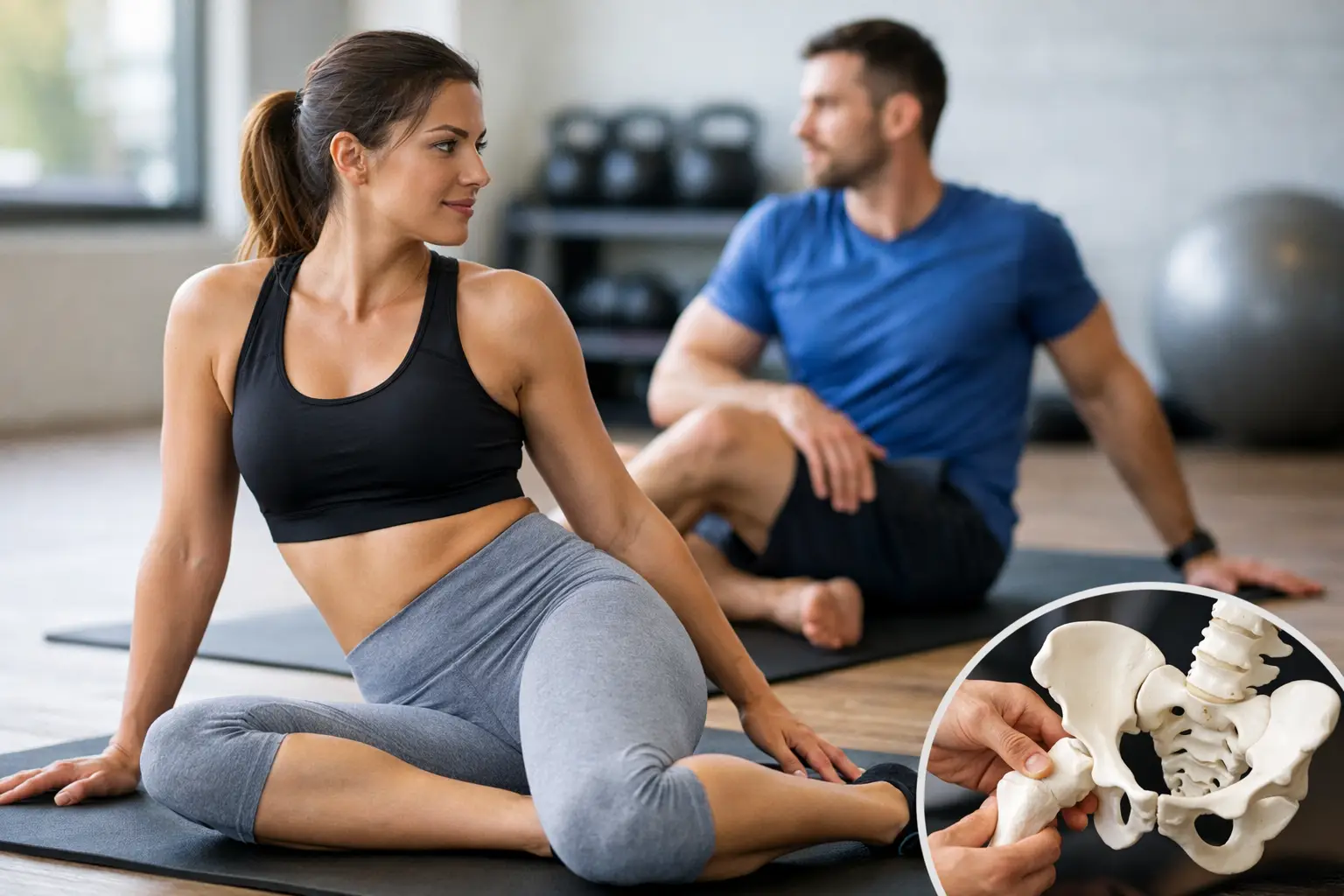
The best drills are usually simple and repeatable. A 90-90 hip rotation is a great place to start because it trains internal and external rotation, which many adults lack. Sit with one leg in front and one leg to the side, both bent at about 90 degrees. Sit tall, lean gently toward the front shin, then rotate to switch sides with control.
Another strong option is the half-kneeling hip flexor stretch with a glute squeeze. Instead of pushing aggressively forward, keep your ribs stacked over your pelvis, squeeze the glute on the kneeling side, and feel the front of that hip open. That tends to work better than turning it into a low back stretch.
Deep squat holds can help too, especially if supported. Hold onto a stable surface, sink into a comfortable squat, and breathe. Shift gently side to side. If a full squat is not available yet, that is okay. Meeting your body where it is will get you further than forcing depth you cannot control.
Strengthen the new range
This is where long-term change happens. Glute bridges, split squats, step-ups, and deadlifts can all support hip mobility when done with good form. They teach your hips to produce and control movement instead of just borrowing motion from the spine.
For example, a split squat can improve hip extension on the back leg while building strength and balance. A Romanian deadlift can improve your hip hinge pattern, which helps you bend and lift with less strain on the back. Side-lying leg lifts or banded lateral walks can wake up the glute medius, which supports pelvic control when you walk, run, and stand on one leg.
If you are doing Pilates or low-impact circuit training, you may already be working on some of these patterns. That is one reason these formats can be so helpful for adults who want better mobility without beating up their joints.
A simple weekly plan that works
If you are wondering how to improve hip mobility without overcomplicating it, keep this practical. Aim for short mobility sessions four to six days a week, even if they only last 8 to 12 minutes. Then include lower-body strength training two or three times a week.
Your mobility sessions might include breathing, 90-90 switches, a hip flexor stretch, and a supported squat hold. Your strength days can reinforce the work with bridges, split squats, hinges, and core exercises.
Consistency matters more than intensity. Ten focused minutes done often will usually beat one long session done only once in a while.
Common mistakes that slow progress
One common mistake is stretching hard into discomfort and calling that progress. More sensation does not always mean better results. If your body feels threatened, it may tighten more.
Another mistake is ignoring the core. The hips and trunk work together. If your core is weak or your breathing pattern is off, your hips may not move as freely as they could.
It is also easy to focus only on the front of the hips. Tight hip flexors get a lot of attention, but many people also need better rotation, stronger glutes, and improved hamstring control. It depends on your posture, training history, and daily routine.
And finally, do not overlook recovery. If your training volume is high, your sleep is poor, or stress is running the show, your body may hold tension more easily. Mobility is not only about drills. It is also about the environment your body is living in.
When to get extra support
If you feel pinching in the front of the hip, sharp pain, numbness, or discomfort that keeps getting worse, it is worth getting professional guidance. Not every mobility issue should be pushed through. Sometimes the right answer is adjusting the movement, improving technique, or getting assessed before doing more.
For many people, coaching makes the process much clearer. Small changes in alignment, tempo, or exercise selection can make a big difference. In a supportive studio setting like TNT Fitness Studio B, that kind of feedback can help you stop guessing and start moving with more confidence.
How to improve hip mobility and keep it
The real goal is not just looser hips for a day. It is hips that feel better during workouts, walks, errands, long drives, and everything else your week demands. That comes from building movement you can own.
Give your hips regular attention, but do not treat them like a problem to fix overnight. Treat them like a part of your body that responds to practice, patience, and smart training. Start with a few focused minutes, stay consistent, and let the progress build. Better movement often starts quietly, then shows up everywhere.