Walking into your first Pilates session can feel like the first day of school – a little exciting, a little awkward, and full of questions you do not want to say out loud. That is exactly why this beginner pilates class guide exists. If you are curious about Pilates but unsure what happens in class, what you should wear, or whether you are “fit enough” to start, the short answer is yes – you can start now.
Pilates is one of the most approachable ways to build strength, improve posture, and move with more control. It is low impact, but that does not mean easy. It challenges muscles in a thoughtful way, especially through the core, hips, glutes, and back. For many beginners, that balance is what makes it stick. You leave feeling worked, but not beaten up.
What a beginner Pilates class is really like
A good beginner class is not about performing advanced movements or keeping up with the strongest person in the room. It is about learning how to connect breath, posture, and controlled movement. You will usually move through a series of exercises that focus on alignment, core stability, flexibility, and overall body awareness.
Most classes begin with simple setup cues. Your instructor may guide you to notice how your spine is positioned, how your ribs are stacked over your hips, and how to engage your core without holding your breath. That early coaching matters. Pilates is less about rushing through reps and more about doing fewer repetitions with better form.
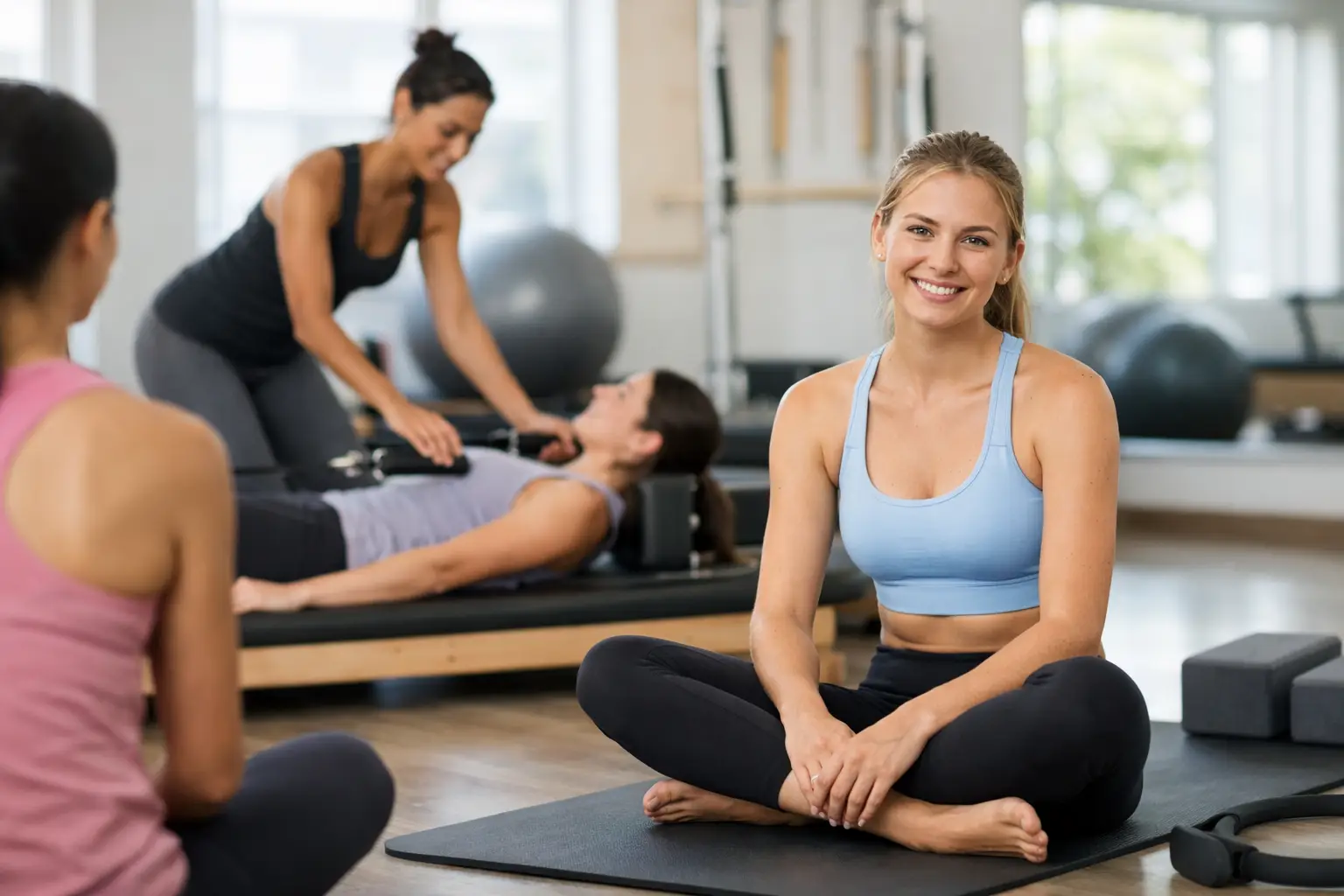
Depending on the studio, your first class may be mat-based or equipment-based. Mat Pilates uses body weight, and sometimes small props like bands, rings, or light weights. Equipment classes might use a reformer or other specialized machines. Neither option is automatically better for beginners. It depends on the teaching style, your comfort level, and whether you benefit more from bodyweight basics or guided resistance.
Beginner Pilates class guide: what to wear and bring
You do not need a trendy matching set or a fitness background to fit in. Wear comfortable workout clothes that stay in place as you move. Leggings, fitted joggers, or shorts paired with a T-shirt or tank usually work well. Clothes that are too loose can make it harder for your instructor to see your alignment and offer useful corrections.
Grip socks are often recommended, especially in equipment classes or studios with smooth floors. They help with stability and keep movement safer. Bring water, although many Pilates classes are not built around frequent breaks. You may also want a small towel if you tend to sweat, but expect more focused muscle work than high-intensity cardio.
If you have injuries, recent surgeries, chronic pain, or are pregnant, tell the instructor before class starts. That is not oversharing. It is smart. Good coaching always works better with context.
What you can expect to feel in your first session
A lot of first-timers expect Pilates to be mostly stretching. Then class starts, and suddenly the tiny muscles around the hips, abs, and shoulders are shaking. That is normal. Pilates often targets stabilizing muscles that do not get much attention in daily life or even in traditional strength training.
You may notice that the workout feels slower than a bootcamp or circuit class, but do not mistake slower for easier. Controlled movement creates a different kind of challenge. You are not using momentum to get through the exercise, so your muscles have to do more of the work.
You might also feel a little mentally busy at first. There are breath cues, posture reminders, and movement patterns to learn. Give yourself time. Your first class is not a test. It is an introduction.
The most common beginner concerns
One of the biggest worries people have is flexibility. Many assume they need to be flexible before trying Pilates. Actually, Pilates is one of the ways people become more flexible because it improves strength and control through a fuller range of motion.
Another common concern is core strength. If your core feels weak, that is a reason to begin, not a reason to wait. In Pilates, “core” does not only mean six-pack muscles. It includes the deep muscles that support your spine, pelvis, and posture. Building that foundation can help everyday movement feel better, from standing at your desk to lifting groceries.
Some beginners also worry about keeping up. In a well-taught class, you should not feel pressured to perform every move at the highest level. Modifications are part of good instruction, not a sign that you are behind. In fact, taking the right modification often leads to better progress because you are learning the movement correctly from the start.
How to get more out of your first few classes
The biggest win in the beginning is consistency, not perfection. If you take one class and immediately decide you are either “good” or “bad” at Pilates, you are judging way too early. Most people need a few sessions to get comfortable with the language, pacing, and body positions.
Try to focus on three things in your first few classes. First, listen for alignment cues. Second, breathe steadily instead of tensing up. Third, let your instructor know when something does not feel right. Those habits matter more than trying to look advanced.
It also helps to stay patient with soreness. Pilates soreness can show up in unexpected places, especially around the mid-back, glutes, inner thighs, and deep abdominals. Mild soreness is common when you start, but sharp pain is not. There is a difference between muscles working and joints feeling irritated.
Why beginners often do well with Pilates
Pilates meets a lot of people exactly where they are. If you have spent years sitting at a desk, dealing with tight hips, rounded shoulders, or low back tension, the focus on posture and controlled strength can be a real reset. If you already exercise, Pilates can fill in gaps by improving stability, coordination, and movement quality.
That is part of why beginners often stick with it. Progress is not limited to what you see in the mirror. You may notice you stand taller, feel stronger during walks, move more confidently in other workouts, or have less stiffness at the end of the day. Those changes are meaningful because they affect real life.
There is also a confidence factor. When people feel supported and coached, they are more likely to keep showing up. That matters just as much as the workout itself. At a community-driven studio like TNT Fitness Studio B, beginners can build skill in an environment that values progress, not intimidation.
How often should a beginner start?
For most people, two to three Pilates classes per week is a strong starting point. That gives you enough repetition to learn the movements without overdoing it. Once a week can still help, especially if you are pairing it with walking, strength training, or other movement, but progress usually feels slower.
More is not always better in the beginning. If your body is adjusting to new movement patterns, recovery still matters. You want to leave class feeling challenged and energized, not so sore that you dread coming back.
This is where personal goals matter. If your focus is better mobility and posture, a steady twice-a-week routine may be enough. If you want to improve core endurance, body awareness, and overall strength faster, three sessions plus other balanced activity can work well. The right pace is the one you can maintain.
Signs you found the right class
The right beginner class should make you feel guided, not lost. You should hear clear cues, get practical modifications, and leave understanding your body a little better than when you walked in. Feeling challenged is normal. Feeling confused the entire time is not.
Look for instruction that emphasizes quality over speed. A strong Pilates teacher will explain not just what to do, but why it matters. That helps beginners build trust in the process and stay motivated when movements feel unfamiliar.
You should also feel comfortable asking questions. A supportive studio culture makes a real difference, especially when you are new. Fitness works better when it feels personal, encouraging, and realistic.
Your first class does not need to be perfect
There is no prize for looking polished in your first Pilates class. You do not need to know the terminology, have perfect posture, or nail every movement on day one. You just need to start.
If you stay open, listen to coaching, and give your body time to learn, Pilates can become one of the most useful tools in your routine. It builds strength that carries into everyday life, mobility that helps you move better, and confidence that grows with every class.
Show up as you are. Let the first class be the first step, not the final judgment.